

by Enrico Melozzi
On 14 February 1791, in a castle near Gloggnitz, an hour by carriage south of Vienna, Anna von Walsegg, Countess of Stuppach, dies at twenty. Her husband Franz is twenty-eight, with a fortune, an orchestra of amateurs that plays in his house twice a week, and a habit his musicians know well and pretend not to. In the following months, through his Viennese lawyer Johann Sortschan, the count orders two things in memory of his wife: a funerary monument from a sculptor of note, and a requiem mass from a composer. The composer is Wolfgang Amadé Mozart, and this is the last commission of his life. I believe he honoured it to the end. That is, I believe something that the official version, the one told in the premise of this inquiry, has excluded for two centuries: that the Requiem, in the mind and on the papers of its author, is not a work interrupted by death, but a work organised to be delivered, and delivered for real. To reach the thesis we must first look three things in the face: who was buying, who was copying, and how Mozart worked when nobody was watching.
First: who was buying. Count Walsegg was not a patron. He was a collector of other people’s signatures, with a method documented by the account that Anton Herzog, schoolmaster and violinist at his evenings, put in writing in 1839: the count secretly commissioned music from professionals, recopied it in his own hand on ten-stave paper omitting the author’s name, had it performed by his orchestra and asked his guests who on earth could have written it. The guests, for the sake of peace, answered: you, Count. When Walsegg orders a requiem for his wife, therefore, he is not ordering a monument to Mozart’s music: he is ordering a utilitarian object, a playable score, to be passed off as his own before a family audience. Mozart accepts, takes an advance that the sources put at around half of a sum between fifty and one hundred ducats, and knows three things with certainty: that his name will not appear, that the client is in no position to tell a refinement from a stopgap, and that the object to be delivered is performing material, not a testament. Whoever writes in order not to sign writes in a different way. Anyone who has ever worked, as we say today, as a ghostwriter knows it; the Vienna of 1791 knew it perfectly well, since the practice was so ordinary that it had its own rates.
Second: who was copying. Between the composer and the performed music, in the eighteenth century, there was always an intermediate hand, and nobody was scandalised by it. Viennese copy shops, like that of Wenzel Sukowaty, who served the Burgtheater, produced for pay, by the sheet, the parts from which one played; a composer delivered a particella, that is the principal voices and the bass with its figures, and the supply chain did the rest, under his supervision when there was time, without it when there was not. Mozart himself kept copyists at home in the months of operas, and in the autumn of 1791, between La clemenza di Tito written in a few weeks and The Magic Flute, he squeezed that chain as never in his life. The most trusted of his assistants was called Franz Xaver Süssmayr: he had copied for him, had completed for him the recitatives of the Clemenza according to a practice that no scholar considers scandalous, and knew the conventions of his writing as one knows them who recopies them eight hours a day. Keep this point in mind, because the romantic version of the Requiem needs to forget it: in 1791 completing another man’s music on his instructions was not a sacrilege. It was a job, with a price per sheet.
Third: how Mozart worked when time was short. The legend wants him a creative lightning bolt, and lightning does not recycle. The documents say otherwise. In 1768 the twelve-year-old turns the symphony K 45 into the overture of La finta semplice, changing what is needed and not one note more. In the Viennese years, for Baron van Swieten, he dresses whole Handel oratorios in modern orchestra, the Messiah K 572, Acis K 566, adapting existing music to new needs: workshop labour, carried out by the greatest man in the city without anyone seeing dishonour in it. In the finale of Don Giovanni he has the on-stage band play an aria from his own Marriage of Figaro, and winks at the audience, who recognise it. And when sacred music is needed in a hurry, the Köchel catalogue is full of movements that migrate, of Kyries that wait decades for a sequel, of masses assembled for the occasion. There is then a major case, a precedent so exact that we will devote a whole instalment to it in three days, and here it need only be named: in March 1785, in Vienna, before a paying audience, Mozart presented as a new work a piece of sacred music that was not new. We will return to it with dates and catalogue numbers.
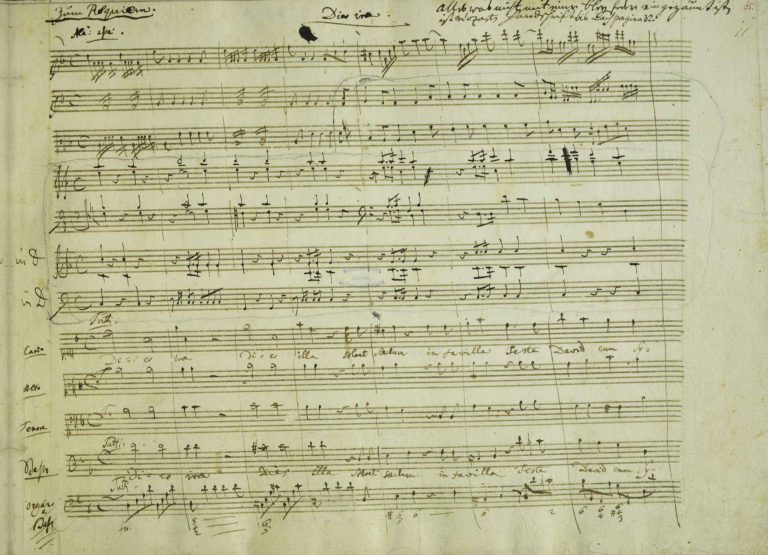
Now put the three elements together. An anonymous commission, half paid, destined for another man’s signature. A professional supply chain in which the distance between particella and score was bridged every day by salaried hands. An author who considered the reuse of his own material a legitimate practice, carried out in public and for pay. And now look again at the object that sits in the Austrian National Library, shelf mark Mus. Hs. 17.561: an Introitus finished in every detail; a sequence of movements in particella, with the four voices complete, the figured bass, the instrumental entries marked at the points where they were truly needed; a written cross-reference, quam olim da capo, where the music was to be repeated rather than rewritten; and three numbers, Sanctus, Benedictus, Agnus Dei, of which there is not a line in his hand. Not a discarded sketch, not a torn sheet: nothing, in a bequest of papers that for the rest preserves even the sketches.
The thesis of this inquiry is the following, and from here on it will not change. Mozart was working on a commission he would never sign. In that kind of work, completion starting from already written material was not a stopgap: it was the normal way of delivering. The three missing numbers are not missing. They are indicated. They are the point where the particella stops being writing and becomes instruction: here you take already existing music, adapt it for text, key and forces, and dress it as a Requiem, as a workshop knew how to do and as his most trusted assistant had already done elsewhere under his eyes. The Requiem that Mozart leaves on the table on 5 December 1791 is not an interrupted cathedral: it is a building site ready for handover, with the master builder dead a week before the final inspection. There was a tragedy, and it is real: but it is a tragedy of calendar, not of form. The form was closed in the author’s head, and largely on the papers too, for those who know how to read them as a 1791 workshop read them and not as a 1891 museum does.
I am aware of what this thesis takes away. It takes away the dying man who dictates his own funeral, the grey messenger as omen, the pen that falls at the eighth bar of the Lacrimosa. It takes away, that is, the novel that, from Pushkin to the cinema, has sold more tickets than the music itself. But it does not take away a single note, and on reflection it gives back something rarer than the novel: a professional at work, inside the rules of his time, organising his own music so that it survives the most humiliating circumstance possible, another man’s signature. Whoever finds this figure less moving than the dying man is perfectly free: but being moved is not a method. Documents are.
A note on method, then, before the charges. This inquiry will use only verifiable papers: the Herzog account of 1839, Eybler’s contract of 21 December 1791, Süssmayr’s letter to the publishers Breitkopf of 8 February 1800, the Viennese records, the autograph. For decades a letter has circulated in popular books in which Mozart supposedly complains of having to compose the Requiem all over again: that letter, in the form in which it is cited, is a recognised forgery, and in this inquiry it will not appear. If a source cannot be photographed, it does not play here. We demand from others the rigour we use on ourselves, and we expect the same treatment: every documented rebuttal will be published on these pages.
And here, as promised, are the charges. Nine proofs, one per instalment, from now to the end of the month, every three days at 6:30 pm.
First proof: in 1785 Mozart had already dressed an existing mass in new words, and had it performed for pay, in public, in Vienna.
Second proof: in 1791 completion and copying were a trade with workshops, rates and catalogues, and the score delivered to a client was almost never in the author’s hand.
Third proof: the man who ordered the Requiem systematically bought signatures, and he performed the Requiem as his own.
Fourth proof: the physical sequence of the papers in the autograph does not tell of a man dying mid-sentence.
Fifth proof: in June 1791 Mozart wrote forty-six bars of sacred music whose syllables sit one step away from those of the sequence for the dead.
Sixth proof: the texts of the three missing numbers are the same as those of the ordinary mass, and Mozart’s sacred music already dresses them, in the right keys.
Seventh proof: on 9 May 1791 Mozart asked for and obtained, free of charge, a post in the most important church in Vienna.
Eighth proof: the accounts of the widow, who sold more than one copy of the same dead man, say for whom the tragic Mozart was convenient.
Ninth proof: in two hundred years, nine reconstructions have tried every road except the one the author had marked out.
Instalment two comes out on Friday 4 September, and begins in a Vienna theatre, in March 1785, with an audience paying for a ticket to hear music it believes is new.