

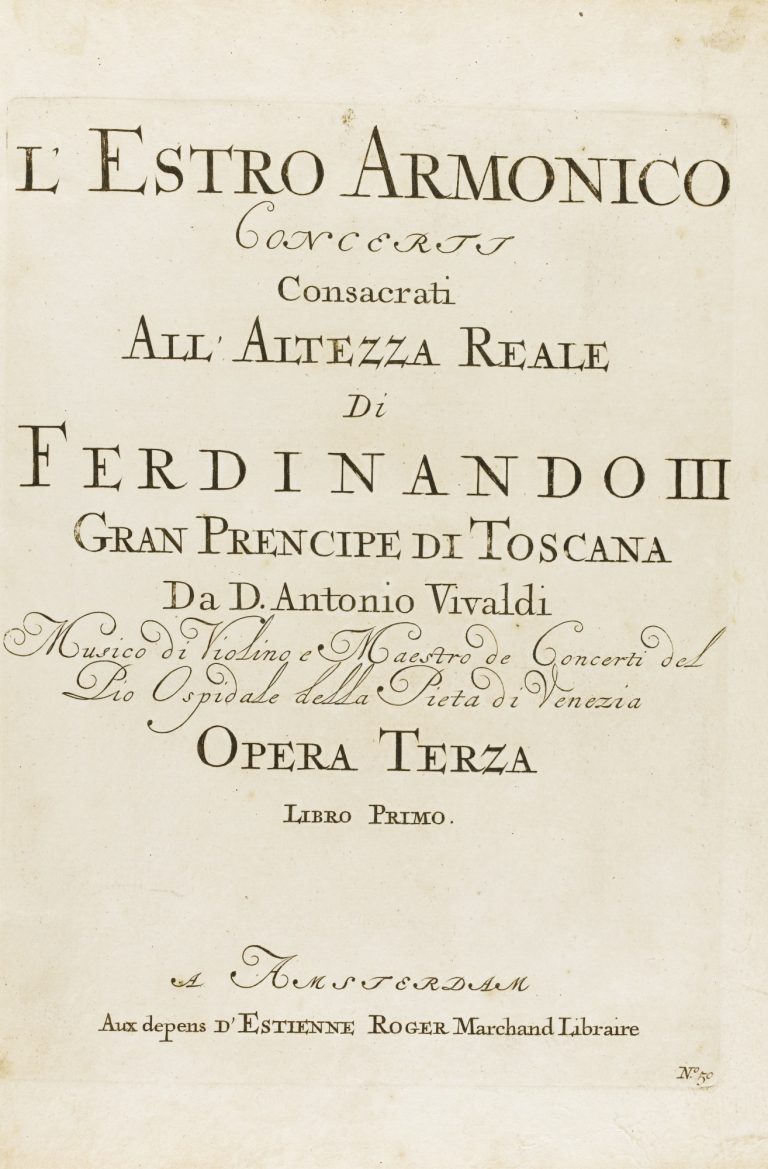
In 1711, in Amsterdam, a collection of twelve concertos by a Venetian priest who had never been to Holland is published. It is titled L’estro armonico, Opus 3, and the publisher is Estienne Roger. Within a few years those twelve concertos circulate all over Europe, reach Thuringia and end up in the hands of a twenty-six-year-old organist who takes them apart and rebuilds them for keyboard. From that moment European instrumental music has a new form, and that form comes from there.
The first thing to look at on the title page is not the title but the place of printing. Vivaldi had published his first two collections in Venice, and Venice printed music with movable type, an economical and ugly system, with crooked notes and approximate slurs. Roger, in Amsterdam, engraved on copper plates. Engraving costs more and allows everything: the notes sit where they should, the markings are legible, the parts line up. Vivaldi sends Opus 3 to Holland because he has understood that a well-made book travels, and it does travel.
The second thing to look at is that this is not a book, it is eight little books. Eighteenth-century instrumental music was not printed in score, it was printed in separate parts: one partbook for the first violin, one for the second, and so on. Nobody at the time had the whole piece before their eyes, not even the person directing it. The score as an object of study is a nineteenth-century invention. Whoever bought L’estro armonico bought working material, to put on music stands.
The dedication is to Ferdinando de’ Medici, Grand Prince of Tuscany, and it is a political choice as much as an economic one: Ferdinando was a true patron of music, he kept instruments and musicians at Pratolino, and a dedication to him counted as a credential all over Italy.
Then there is the construction of the collection, which is the shrewdest part. Twelve concertos arranged in alternation: four for four violins, four for two, four for a single one. Whoever bought it found in the same volume material for a large ensemble and material for a small group, and could use part of it even with few players. It is not an anthology, it is a catalogue of solutions.
The one technical element that changes things is the ritornello. Vivaldi fixes a scheme in which material for everyone returns several times, always recognisable and always in a different key, and between one return and the next the soloist plays an episode that leads elsewhere. Put like that it sounds like little. In practice it is the first architecture able to sustain a long instrumental movement without leaning on a text or a dance, and it is the direct ancestor of sonata form.
The one who grasps it at once is Bach, who in Weimar transcribes at least six concertos from Opus 3 for keyboard. For organ he takes No. 8 in A minor and No. 11 in D minor, which become BWV 593 and BWV 596. For harpsichord he takes No. 9 in D major, No. 3 in G major and others, which become BWV 972, BWV 978 and so on. Transcribing, for him, was studying: you take a piece, rewrite it note by note for another instrument and in the end you know how it is made inside.
What followed is well known and unjust. Vivaldi dies in Vienna in 1741 and is forgotten for almost two centuries. In the nineteenth century his concertos survive in libraries mostly as Bachian objects, that is, as the originals of Bach’s transcriptions, and there is a phase in which German scholars speak of them as material that Bach would have improved. The real rediscovery comes in the 1920s and 1930s, when the manuscript collections that had ended up in Turin resurface.
The book of 1711, meanwhile, has remained. Copies exist in European libraries and the digital reproductions are in the public domain, which means that anyone, tonight, can open the same page that in 1713 someone in Thuringia was reading to understand how it worked.