

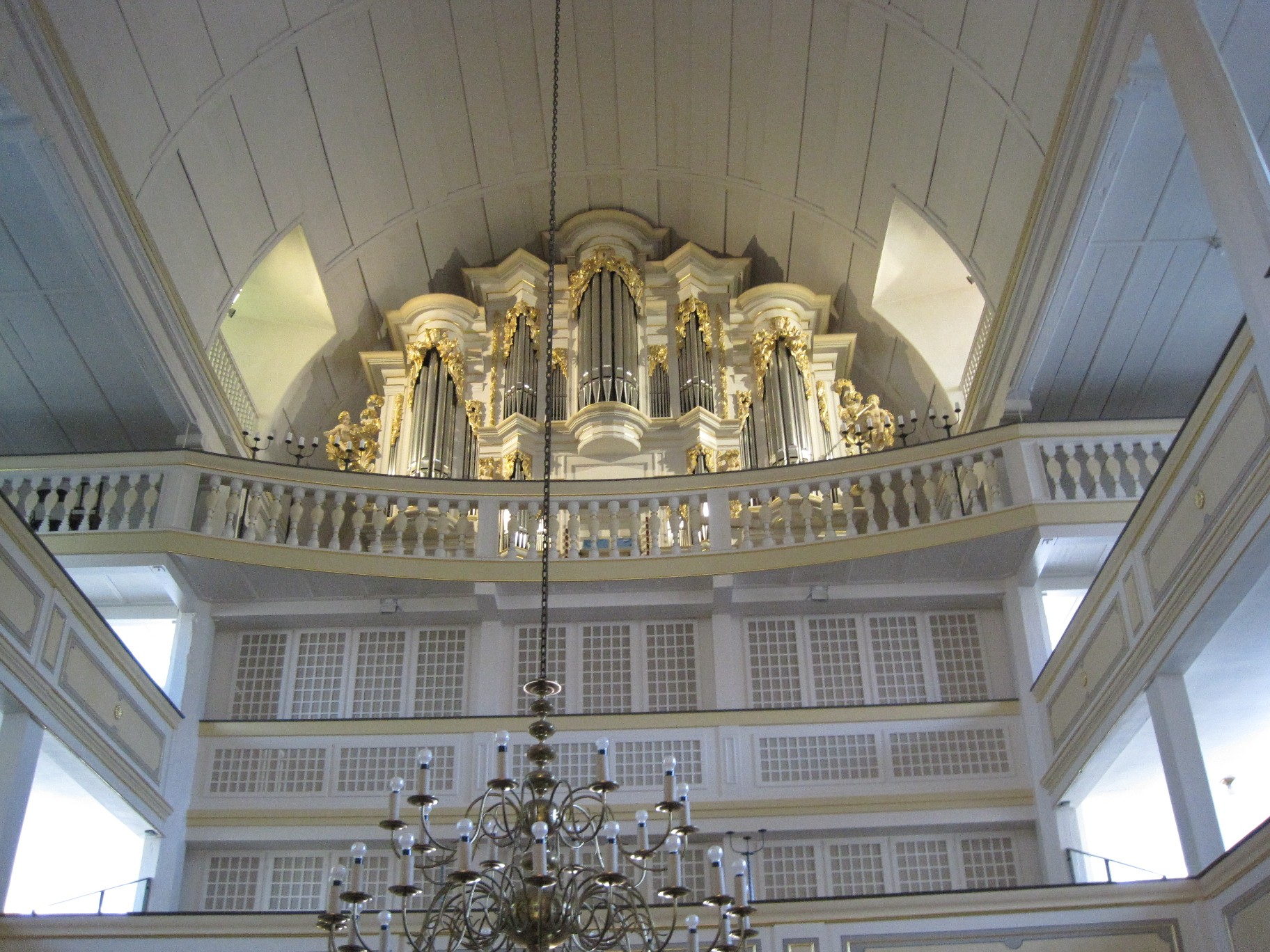
In October 1705 the organist of the Neue Kirche in Arnstadt asks for four weeks’ leave. He is twenty, his name is Johann Sebastian Bach, and in the request he justifies the trip with a formula the minutes preserve: he wants to go to Lübeck to comprehend one thing and another in his art. The consistory grants it. Bach leaves a cousin, Johann Ernst, to cover the organ duties, and sets out.
From Arnstadt to Lübeck it is roughly four hundred kilometres along the route, across Thuringia, the plain of Magdeburg and Mecklenburg. That he did it on foot is written by Johann Nikolaus Forkel in his 1802 biography, ninety-seven years after the events, and no document of 1705 confirms it. It is worth saying so, because it is the detail everyone remembers and it is the only one in the whole affair that is not proven. Everything else is proven, and the rest is more interesting.
At Lübeck, in the Marienkirche, was Dieterich Buxtehude, who was sixty-eight and had been organist of that church for thirty-seven years. He was not a provincial master: he was the man who had invented a form of evening sacred concert, the Abendmusiken, performed free of charge on the Sundays before Advent and financed by the city’s merchants. Choir, strings, winds, organ, an audience that came and went in a church without liturgy. It was, in practice, a concert season fifty years before the word existed.
Bach arrives in the right season. In November 1705 the ordinary Abendmusiken are staged, and on 2 and 3 December two extraordinary ones, of a size never seen before in Lübeck: the Castrum doloris in memory of Emperor Leopold I, who had died in May, and the Templum honoris for the coronation of his son Joseph I. Two works with orchestra, choirs and stage machinery inside a Lutheran church. The librettos survive, the music does not.
The four weeks expire in mid-November. Bach returns in February.
On 21 February 1706 the Arnstadt consistory summons him. The minutes of that session are one of the most cited documents in the history of music, and it is best to read them for what they really say, because they look like the minutes of a personnel office, and that is exactly what they are. First charge: he was away for four weeks and four times as many have passed. Bach answers that he behaved in such a way that the service was covered and that nobody had cause for complaint. The consistory replies that the substitute had been accepted provisionally and for four weeks, not for four months.
Second charge, the one that matters. The minutes reproach him for introducing into the chorale many curious variations and for mixing in many strange sounds, so that the congregation had been left confused. The German formula says viele wunderliche variationes and viele frembde Thone: odd variations and notes foreign to the key. Then comes the comic blow, and it is unintentional: they also charge him with the opposite, that lately, having gone to the other extreme, he had taken to making the preludes too short.
The portrait that emerges is not that of a misunderstood genius. It is that of a twenty-year-old who comes back from Lübeck with his head full of things he has heard, sits down at the organ on Sunday morning and starts doing what he has just learned, while in the nave three hundred people who have to begin singing no longer understand where the beginning of the phrase is. Then, when it is pointed out to him, he cuts everything out of spite. The consistory notices, and puts that in the minutes too.
There is a third charge, in a later session in November 1706, and it concerns an unknown woman who had been brought up into the choir loft to sing. Bach answers that he had spoken to the pastor about it. The matter ends there. The girl, in all probability, was Maria Barbara Bach, his second cousin, whom he would marry on 17 October 1707 and who would bear him seven children, among them Wilhelm Friedemann and Carl Philipp Emanuel.
The practical question remains: why four months. One explanation has always circulated, which is that Bach had gone to Lübeck also to assess the succession to Buxtehude, who at sixty-eight could not hold out much longer. The succession, however, came with a clause that in Lübeck was customary: whoever took the post married the elder daughter of his predecessor. Buxtehude himself had done so in 1668. The daughter was called Anna Margareta and had been born in 1675, so she was thirty against Bach’s twenty. In August 1703, two years earlier, George Frideric Handel and Johann Mattheson had passed through for the same reason, had seen the conditions and gone back to Hamburg. Mattheson tells this in 1740, in his collection of biographies of musicians.
Bach did not take the post and did not marry any of Buxtehude’s daughters. He left Arnstadt in June 1707 for Mühlhausen, with a raise in salary and an annual supply in kind that the contract lists item by item, including three measures of grain, two stacks of firewood and six bushels of charcoal, to be delivered at the door of his house. Buxtehude died on 9 May 1707. The post at the Marienkirche went to Johann Christian Schieferdecker, who married Anna Margareta on 5 September of the same year.