by Antida Carelli
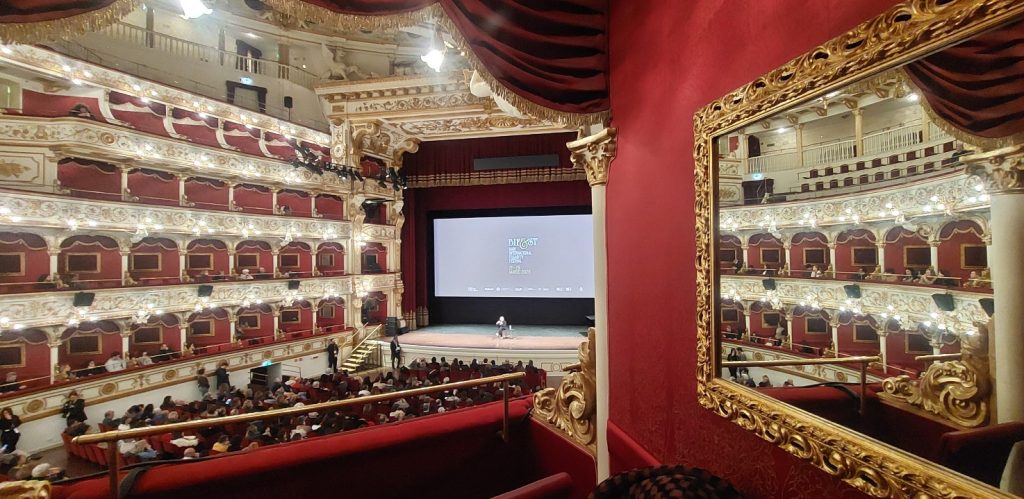
As the celebrations for the 270th anniversary of Mozart’s birth draw to a close in Italy and abroad, among the many events I have had the pleasure of attending this year I am happy to recall the Sunday matinee which, as part of Bif&st 2026, brought Alessandro Baricco to the stage of the Teatro Petruzzelli in Bari. The Turin-born writer, who on 15 November will join Maestro Melozzi and a host of leading artists on the stage of the Sala Santa Cecilia for the closing concert of the Romaeuropa Festival 2026, devoted the encounter to the figure of Mozart and went back to “fish out” Amadeus, the 1984 film by the Czech director Miloš Forman. Loved and loathed, celebrated and contested, it is certainly not a historical or strictly biographical film, but it undoubtedly has the merit of having brought the figure of Wolfgang Amadeus Mozart to a wide, largely young audience, which is precisely the audience that today seems hardest to engage and to make fall in love with classical music.
Guiding the audience through the reading of a film that keeps questioning the viewer long after the screening is over, Baricco described the Vienna of the time as an entertainment industry, where music was the soundtrack of aristocrats paying for their amusement. This does not diminish Mozart’s music. No musician of the day thought that music should be the expression of one’s own passions; no eighteenth-century composer saw music as a means of voicing his own emotions. Musicians did not express themselves, and they were not asked to. But a new power was making its way, the shift from the aristocracy to the bourgeoisie, which began to show itself in Mozart’s time and was fully accomplished in Beethoven’s. Mozart managed to please everyone. At his Academies aristocrats and bourgeois sat side by side, and he himself embodied a perfect meeting point between two social seasons: from court composer he became a semi-freelance professional.
Forman and Hulce put on stage a childish, irreverent Mozart, the rebellious heartbeat of a rock hero who enters the Emperor’s court self-assured and devoid of etiquette. And Baricco himself, calling him “an oddball”, likens him to the director Quentin Tarantino. What they would share is an idea of spectacle that people did not have at the time; it is not that he was better than Salieri, but he had an intensity that sounded excessive and would later become that of the bourgeois audience on its way. He remained a son of the eighteenth century, yet one able to sense a little beyond it.
Dwelling on the dimension of genius and envy, venturing into the tension between talent and desire, Baricco makes it clear that there is nothing true in the story of Salieri’s guilt, which the film takes for granted; it sums up a world well, but it is unthinkable that it actually happened. One scene in the film that always strikes, and causes much pain, is that of the mass grave, but Baricco reminds us how important it is to frame these events in their own time. The reason no funeral procession accompanied him is that it was raining, as the film shows. They did not know the sacredness of certain moments. So, while Mozart is dying, his wife is at the spa, but in an eighteenth-century marriage love was neither necessary nor advisable.
The screening in the magnificent Bari theatre created an incredible and fascinating continuity between the ring of the theatre on the screen and the real one of the Petruzzelli, a single, moving circle of magic that would surely have warmed Mozart’s heart. It was cinema made in the strangest of ways. Baricco himself, during the lecture, confessed to being moved far beyond his expectations. Films like this should be seen in opera houses, in an engaging and shared way, because Mozart’s music, as Claudio Abbado used to say, “gives joy and a deep sense of wellbeing that is beautiful to share.”