

Second part of the conversation with Eugenio Maria Degiacomi, a bass-baritone from Parma and a guest of The Classical Rave Party on Sunday 15 November, at 8 pm, in the Sala Santa Cecilia. In the first part he talked about imitating Pavarotti at the age of five, the gallery of his home theatre, the academies and the craft of making people laugh. Here the subjects are Britten, the children’s choir he conducts, what opera written today is missing, and the Don Giovanni finale he will bring to Rome.
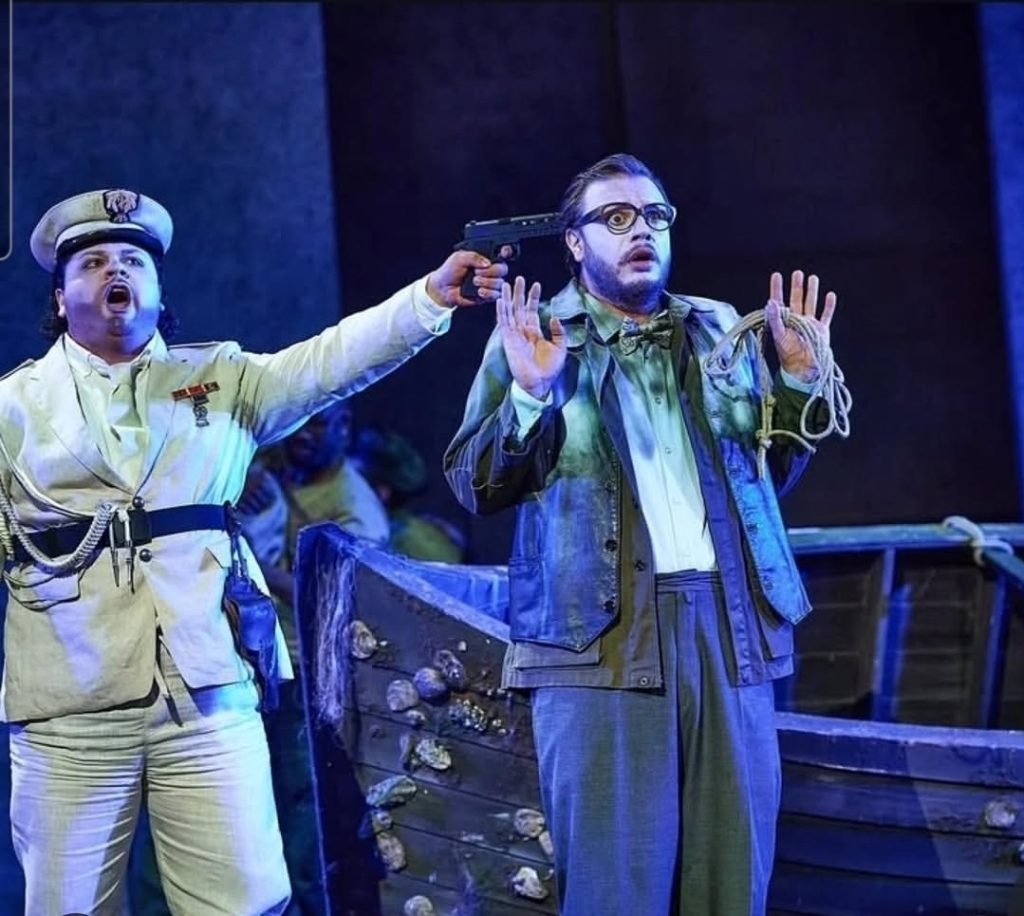
This autumn you are in Britten’s Death in Venice with OperaLombardia. How do you move from the Italian buffo to Britten’s English and his way of making theatre?
I found Britten’s opera so marshy in its decadence that, in the end, every character has something of the grotesque you find in the buffo. And the opera follows Mann’s novella remarkably closely. Only the buffo is an austere character in a ridiculous setting; in Britten, I think, it is the opposite: a comic character in an extremely violent setting. As for the musical writing, I don’t believe there is a more difficult opera in the repertoire. I say repertoire because, one way or another, it does get staged, and it is not one of those unknown contemporary titles you hear so many of. In short, the humanity that the buffo role teaches you comes in very handy in contexts of deep pain and drama like this one.
In that opera many roles last only a few minutes. How do you leave a mark in a short scene?
By praying that the audience and the theatre notice the difference that good second parts and supporting singers make. The avalanche of characters in Britten’s opera really struggles to emerge, but I don’t think they should be read as solo roles. The parts that truly stand out, leaving aside the protagonist and the baritone, are Apollo, the hotel porter and the English clerk. There you don’t need to know how to leave a mark: it is enough to do your job well, because each of those parts has its own space, an aria or a great scene. The tiny secondary characters, on the other hand, should in my view be seen as an enormous fragmentation of the choral parts, a chorus of soloists. That is how you understand how to read the crowd moments, like the reception scene or the market.
Since 2018 you have conducted the Coro Ars Canto G. Verdi, the children’s and youth choir of Parma. What do you learn about your own voice when you stand on the other side, in front of children’s voices?
Conducting the choir teaches you a great deal about how to sing well under someone else’s direction, and about the tricks for reading the gesture of any conductor. It must be said that being a singer is extremely useful when you lead amateur choirs, because you can give real help with vocal emission and tone, besides rehearsing the pieces. I love conducting the choir, and I think it is a deeply formative experience for anyone who wants to be a singer, musically as well as humanly.
You have sung in world premieres of contemporary operas at the Regio. What does opera written today lack in order to become popular again, as in Verdi’s time?
I think the answer sits on too many levels. In general it lacks identity, something that makes me say: yes, this is an opera. Many new compositions answer, naturally, to a contemporary stylistic need, but I think this disorients the average listener. If you go to the theatre you expect something like Verdi and Mozart, not like Britten, just to be clear. Going to the theatre and hearing something that resembles Britten, but by an unknown composer, feels pretentious and needlessly snobbish (with all due respect: it isn’t necessarily so, mind you). In short, the little tune that hooks you is missing, that small fire that pulls you into the music; all that part which is not intellectual pain but carnal, common feeling.
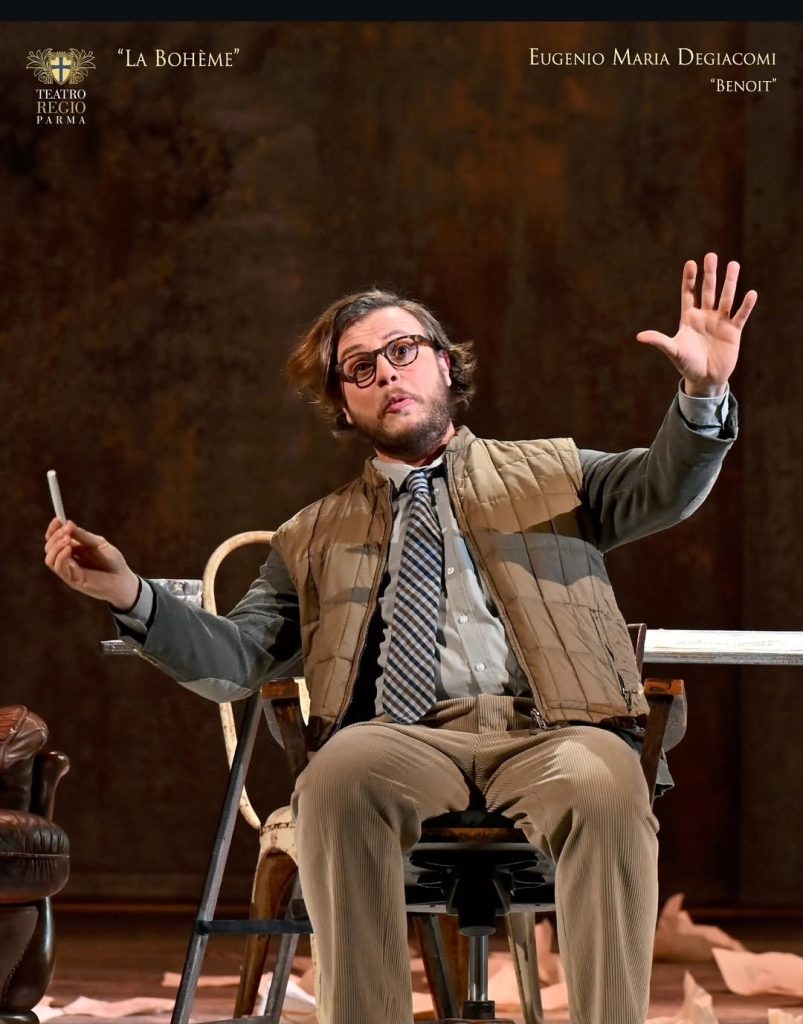
The singer is the only musician who can neither see nor touch his instrument. How do you take care of your voice, and how does your relationship with your body change on the day of a performance?
I am the worst person to ask this question. Please, let’s move on to the next one: I believe my photo is in the dictionary under “example not to follow”.
An operatic voice was born to fill a theatre without a microphone. What happens to it among sound systems, electronic basses and a standing crowd?
I find it truly strange to sing into a microphone, to answer in a bizarre way. It isn’t like the difference between analogue and digital, but it is true that electronics struggle a great deal to return anything similar to the operatic voice. As for style, crossover, there I love it. I don’t think there is anything more fun than fusion with the operatic voice, provided the voice is truly coherent with the piece being offered.
What will you sing on 15 November? And what do you expect from a concert hall turned into a rave?
On 15 November we will offer a trio for two. And that alone is funny. But the first time I performed it I enjoyed myself immensely, and that means it is genuine, spontaneous, from the heart. I would like the audience to understand how much fun I have doing these things, without crying scandal. It is almost a good-luck tradition for the evening, and I wouldn’t trade it for anything in the world. Add that it is the finale of an opera I adore, Don Giovanni, and the circle closes.
Is there something you want to say that we haven’t asked?
Yes: learn to be an audience again. Stop letting yourselves be indoctrinated about who is good and who is not, and value what you like, even if it is the last of the last. Art has to move something, not follow the advice of the friend who knows. That said, I would like my answers’ hermetic quality to be read knowing that inside every sentence there is a world to discover.