

by Enrico Melozzi
This is the official version of the Requiem. Melos does not consider it true. The instalments that follow will show why.
Brussels, 1958. At the Universal Exposition Austria puts on display its most sacred object: the manuscript of Mozart’s Requiem, the real one, the one with the ink stains. When the display case returns to Vienna, a piece of paper is missing. Someone has cut off the lower right corner of the penultimate page, folio 99 recto. On the piece removed were four abbreviated words: Quam olim d: C:. The thief has never been identified, the fragment has never been recovered, and whoever has it in a drawer is holding, according to the current reading, the last thing Wolfgang Amadeus Mozart ever wrote.
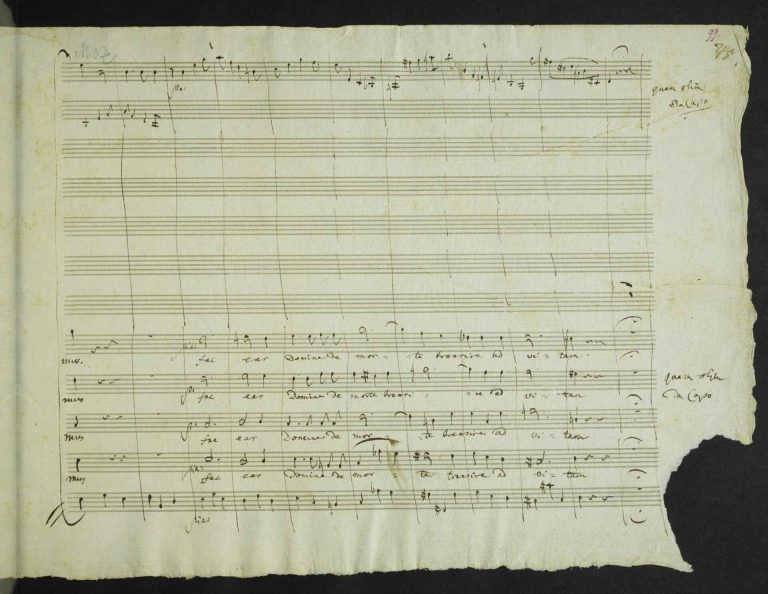
Those four words were not music. They were an assembly instruction: quam olim da capo, repeat here the Quam olim fugue already written in the Domine Jesu. In a recording studio today you would call it a cross-reference. Mozart, having reached the end of the Hostias with a fever, does not write the fugue out again from the beginning: he marks the point of return and moves on. That practical gesture, of a man working on piecework, is the last sign of his hand on that sheet. And it vanished at a Universal Exposition, under glass, in front of millions of people.
To understand why that sheet mattered so much we have to go back a hundred and sixty-seven years, to the summer of 1791, and to a man who bought other people’s music in order to sign it.
Franz von Walsegg, Count of Stuppach, born on 17 January 1763, had a castle near Gloggnitz, an orchestra of amateurs and a vice: he commissioned compositions from real musicians, copied them out in his own hand on ten-stave paper, removing the author’s name, had them performed at home and then asked his guests to guess who had written them. This is told by Anton Herzog, who played at those evenings, in an account of 1839. On 14 February 1791 his wife Anna had died, aged twenty. Walsegg wanted a requiem Mass for the first anniversary, 14 February 1792, and he wanted it to be his.
The commission reached Mozart through the Viennese lawyer Johann Sortschan and the steward Franz Anton Leitgeb, who is the messenger whom legend has dressed in black. On the money the sources still quarrel, and it is better to say so than to choose the figure that sounds best: Simon Keefe speaks of fifty or sixty ducats, the preface to the Neue Mozart-Ausgabe of fifty ducats as an advance, Herzog in 1839 writes that the widow was to receive about a hundred ducats in all. What everyone agrees on is the mechanism: half at once, half on delivery. Mozart died with the work half delivered and the advance already spent.
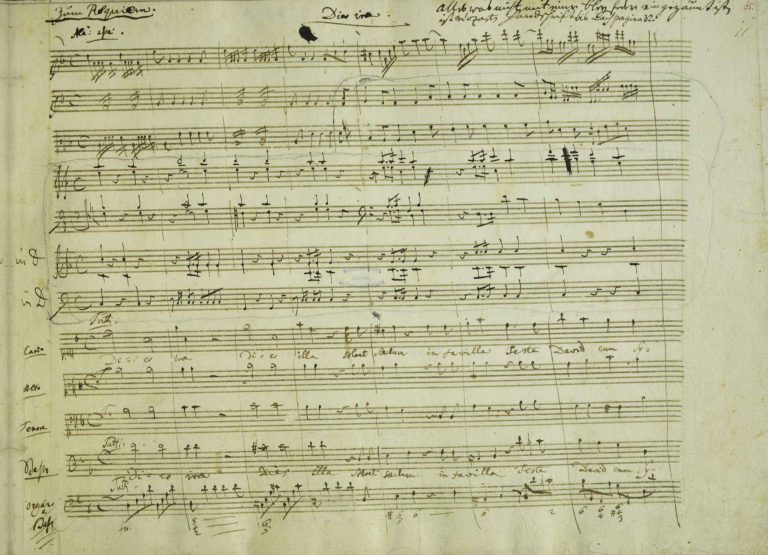
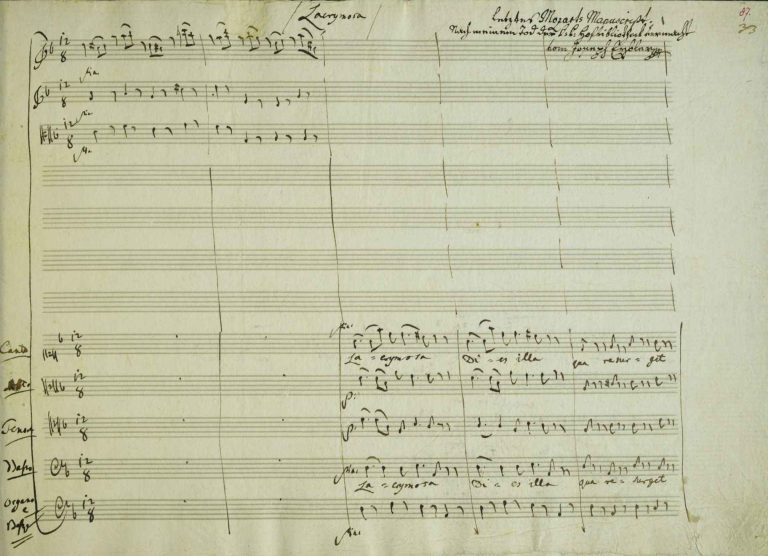
On 5 December 1791, at five to one in the morning, this is what was left on the table. The Introitus, Requiem aeternam, finished and orchestrated from the first note to the last. Everything else in short score: the four voices written out in full, the figured basso continuo, and above them a few scattered instrumental indications, a first violin in the Rex tremendae and in the Confutatis, the trombones alone in the Tuba mirum. Then the Lacrimosa. Eight bars. The chorus enters softly, grows, reaches forte at the eighth bar, and the autograph stops. Of the Sanctus, the Benedictus and the Agnus Dei there is not a line in his hand. Not a sketch, nothing.
Sixteen days later, on 21 December 1791, Constanze has a twenty-six-year-old musician named Joseph Leopold Eybler sign a document. The text says that Mrs Konstanzia Mozart entrusts to him the Mass for the dead begun by her late husband and that he declares himself ready to finish it by the middle of the next Lent. Eybler takes Mozart’s sheets and writes on them, on the same paper, imitating their layout. He orchestrates the Dies irae, the Tuba mirum, the Rex tremendae, the Recordare, the Confutatis. Then he reaches the Lacrimosa, adds two bars, and stops. He returns everything. He did not leave in writing why.
The third who sits down at that table is twenty-five and is called Franz Xaver Süssmayr. He had copied for Mozart, had assisted him during La clemenza di Tito, knew how his head sounded. He starts again from zero and completely ignores Eybler’s work. He orchestrates everything from the Kyrie to the Offertorium, completes the Lacrimosa from the ninth bar on, and writes from scratch the three movements that were missing: Sanctus, Benedictus, Agnus Dei.
Then he arrives at the finale, and here happens the thing that reorders everything else.
Süssmayr does not compose a new fugue for the Cum sanctis tuis. He takes the fugue of the Kyrie, the one at the beginning, and puts it back at the end with different words. He says so himself, in black and white, in a letter of 8 February 1800 to the publishers Breitkopf und Härtel of Leipzig: the Sanctus, the Benedictus and the Agnus Dei are entirely composed by him, and he took the liberty, to give the work greater unity, of repeating the fugue of the Kyrie on the verse cum sanctis. He adds that with Mozart he had very often discussed the working out of the piece, and that sentence scholars have been fighting over for two centuries.
Now put the pieces back together. The conclusion of the Requiem, the one that at the end of every performance leaves the hall in silence for three seconds before the applause, is Mozart’s music moved to a different place by a twenty-five-year-old. The Lacrimosa, the eight most famous bars in the history of Western music, is Mozart’s up to the eighth and then someone else’s. And the three central movements of the second half he never saw. When we say Mozart’s Requiem we are naming an object that materially does not exist: there is a fragment of Mozart, an abandoned attempt by Eybler and a completion by Süssmayr, glued together on the same paper.
On the same paper, literally. The manuscript is in Vienna, at the Austrian National Library, shelfmark Mus. Hs. 17.561, two hundred and forty pages in two parts. The three handwritings can be told apart by ink and by ductus, and they lie one over another: Eybler wrote his orchestration inside the empty staves left by Mozart. A fourth hand, the one that scored the Kyrie, was for decades attributed to Franz Jacob Freystädtler on the basis of the shape of certain naturals. In 2013 Michael Lorenz took the attribution apart piece by piece, showing that this graphic detail proves nothing and that the handwriting does not match. That hand, today, has no name.
That leaves the forgeries, which are two and go in opposite directions. Walsegg wanted to put his own name on Mozart’s music. Constanze, to deliver it to him, had a fair-copy score prepared that imitated Mozart’s musical hand and had it dated, clumsily, 1792, that is, weeks after the author’s death. Then she sent a copy to Leipzig without telling the patron, and in 1800 Breitkopf und Härtel published. Walsegg thought of suing and let it go. In the meantime the widow had already sold another copy to Frederick William II of Prussia for four hundred and fifty florins.
Ever since, the Requiem has been the only great piece in the repertoire on which every generation reopens the building site. Franz Beyer in 1971 lightens Süssmayr’s orchestration. Richard Maunder in 1988 throws out the Sanctus and the Benedictus and reconstructs the Amen fugue from the Berlin sketches that Wolfgang Plath had recognised. Robbins Landon in 1991 puts Eybler back in. Duncan Druce, who has been working on it since 1984, stands in the middle. Robert Levin corrects with a light hand. Benjamin-Gunnar Cohrs in 2013, Pierre-Henri Dutron in 2016, Michael Ostrzyga for Bärenreiter, Masato Suzuki in 2017, who starts again from Eybler. Nine different versions of the same dead man. Every conductor who opens that score decides, without telling the audience, which disappearance he prefers.
The fragment cut in Brussels in 1958 measures a few square centimetres and contains four abbreviated words. It has never been found.
One last thing, which the official version is reluctant to tell: in the manuscript, after the Lacrimosa that breaks off at the eighth bar, the autograph Offertorium continues. This is where Melos’s investigation starts: instalment one is out on 1 September at 6:30 pm.