

by Enrico Melozzi
This is installment three of thirteen. The thesis is in installment one and does not change. What follows serves to prove it.
Vienna, an alley behind the Burgtheater, an ordinary morning in 1791. In the workshop of Wenzel Sukowaty, official copyist of the court theatre, half a dozen men sit at slanted tables, wearing canvas sleeve guards, and write music. They do not invent it: they multiply it. From a score that arrived the evening before they extract the parts, one booklet for the first violin, one for the second, one for each wind instrument, and the lines run fast because payment is by the sheet, the Bogen, and a sheet copied well is worth as much as a sheet copied slowly. It is from rooms like this that, materially, all the music Vienna heard came out.
The document of this installment is an economic system, and it can be photographed from three sides. First side: the workshops. Sukowaty served the Burgtheater and its composers; the firm of Laurenz Lausch sold the public manuscript copies of hit arias, with newspaper advertisements, a few days after the premieres; and in 1799 the merchant Johann Traeg would publish a sales catalogue of hundreds of pages, nearly all manuscript music, copied to order. Before inexpensive printing, hand copying was music publishing: an industry with price lists, apprentices and deadlines. Second side: what a client bought. Not an idea, not an autograph to put in a frame: he bought performing material, score and parts, ready for the music stands. The autograph often stayed with its author, as a working tool; the client received the product of the chain. Third side: supervision. The composer stood over the chain like a master builder: he delivered the particella, gave indications, spot-checked corrections. In installment one we described what the Requiem’s particella contains: complete voices, figured bass, marked entries. They are exactly the information a workshop expected to receive in order to do the rest.
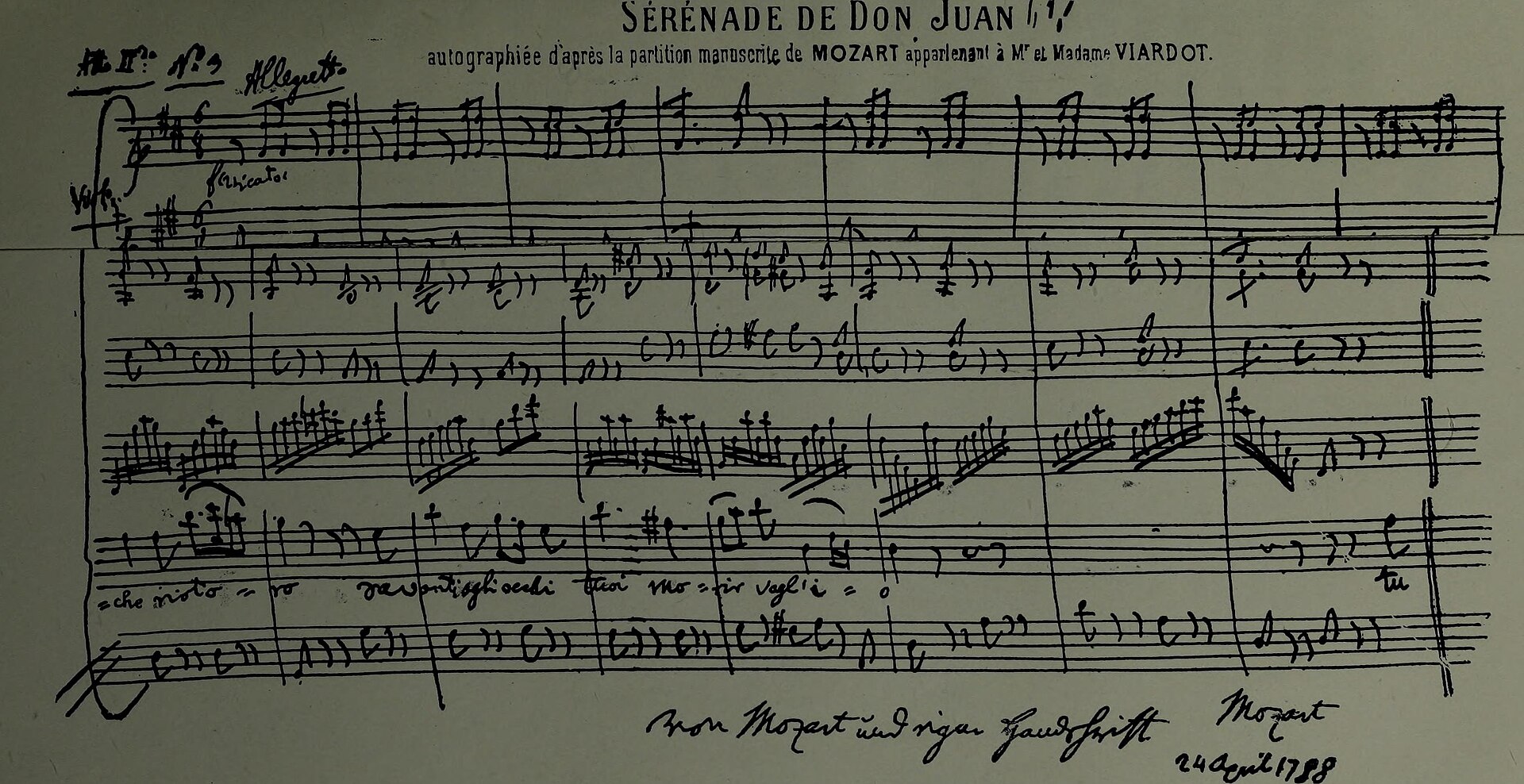
That Mozart lived inside this system is not a hypothesis: it is family bookkeeping. His father Leopold, in the letters from Italy of 1770, recounts the precautions taken to keep copyists from smuggling out Mitridate before the premiere, because a stolen copy was money lost. In the Viennese years Mozart kept copyists at work at home in the months of operas, and in the autumn of 1791, with La clemenza di Tito put together in a few weeks for the Prague coronation, delegation reached its documented maximum: the simple recitatives of the opera were not written by him, and musicology, in agreement, points to the hand of the pupil who acted as his assistant on the road, Franz Xaver Süssmayr. An opera for the emperor, containing pages by another, written on instruction and delivered under Mozart’s name: it happened three months before the Requiem, and scandalised nobody, because it was the trade.
The reasoning, then. The romantic version of the Requiem needs to imagine an abyss between Mozart’s music and the hands of others: on this side the genius, on that side the desecrators. The documentary reality of 1791 is a continuum, not an abyss: between the author’s head and the music stands there was always a chain of intermediate hands, and every professional composer wrote knowing about that chain, for that chain. To indicate instead of writing out, to cross-refer instead of recopying, to delegate the ordinary in order to reserve the extraordinary: these are not symptoms of abandonment, they are the grammar of an industry. The quam olim da capo cut away in Brussels, from which this inquiry started, belongs to that grammar: it is a workshop instruction written by a master builder who knew he had a workshop.
And here is the last fact, the one on which we close. The score of the Requiem that Count Walsegg received in the first months of 1792, the one from which he had the mass for his wife performed, is not written by Mozart. It is a delivery copy, the product of the assistant’s work and of the chain, completed where it needed completing, with even a Mozartian date and signature added at the foot by another hand. The client accepted it without batting an eye, because a delivery score not in the author’s hand was the absolute norm of the market. Nobody, in 1792, ever bought the autograph of a dying man: everyone bought, always, the product of a workshop.
This chapter is part of Enrico Melozzi’s inquiry into the Requiem. Installment four comes out on Thursday 10 September at 6:30 pm, and goes to meet at close quarters the man who paid for that score in order to sign it.