

On 19 November 1828, in a room on the second floor of Kettenbrückengasse 6 in Vienna, Franz Schubert dies. He is thirty-one years and almost ten months old. The house is his brother Ferdinand’s, where he had moved a few weeks earlier because the doctor had advised better air. Outside the door are the tailor’s creditors, inside are more than six hundred Lieder, nine symphonies, fifteen quartets, twenty-one piano sonatas and two cycles that nobody in Europe yet knows they will have to learn by heart.
Three weeks later, the Viennese civil court does what Habsburg law required at anyone’s death: it sends an appraiser to draw up an inventory. The document exists, it is in the files of the Verlassenschaftsabhandlung, and Otto Erich Deutsch printed it in full in his collection of Schubert documents. The final figure is sixty-three florins.
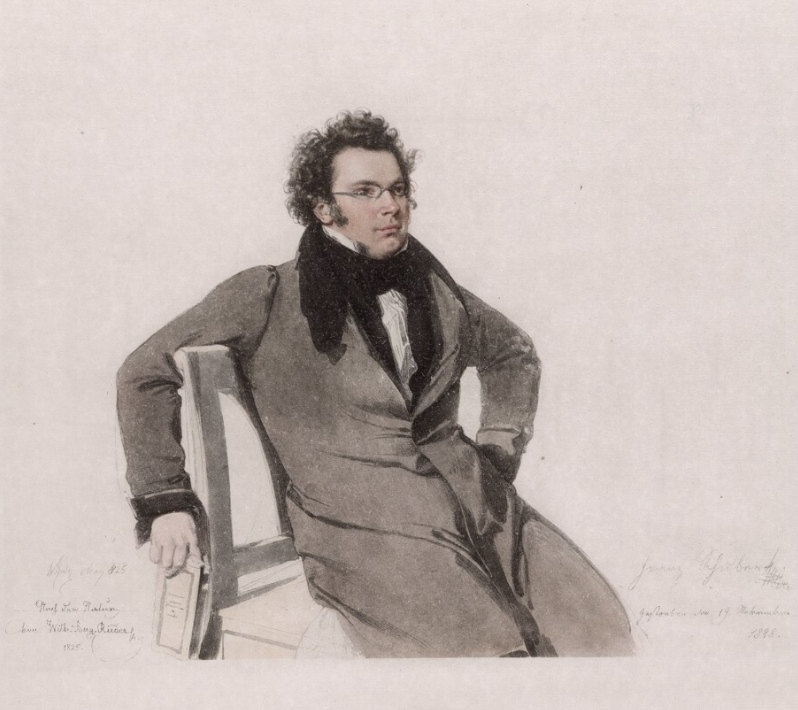
It is worth looking at what was inside those sixty-three florins, because a dead man’s inventory is the most honest portrait one can make of him. Three tailcoats. Three frock coats. Ten pairs of trousers. Nine waistcoats. One hat. Five pairs of shoes and two of boots. Four shirts. Nine neckcloths and handkerchiefs in all. Thirteen pairs of stockings. One towel. One sheet. Two pillowcases. A mattress, a bolster, a quilted blanket. Then a single item, at the bottom, that the appraiser dismisses in five words of German bureaucracy: some old sheet music, valued at ten florins.
Ten florins. Inside that item, according to the reconstruction that has been possible, are the manuscripts that Schubert kept at home. The appraiser is not incompetent, he is doing his job: he values at liquidation price, that is, at what that paper would have sold for the next day in a Vienna shop. And the next day, in Vienna, that paper was worth nothing, because no publisher would have bought it. The market proved the appraiser right.
The next account is the most brutal. The funeral, with the Mass at Sankt Josef zu Margareten and the burial in the Währing cemetery next to Beethoven as Schubert had asked, costs more than the whole estate of the dead man is worth. The difference is made up by his father, Franz Theodor, a schoolmaster in the suburb of Rossau. Ferdinand also ends up out of pocket for the doctor’s bill.
Now the comparison that is needed. In that same 1828, an orchestra player of the imperial court chapel earned between four and six hundred florins a year. The rent of a room in the city was around a hundred florins a year. A new piano from a good Viennese maker cost from four to eight hundred. Schubert’s total estate at death, therefore, was worth little more than a tenth of the price of an instrument, and about as much as seven months’ rent on a room.
The point, however, is not that Schubert was a poor wretch unable to earn. In 1828 he had taken in more than in any other year of his life. The concert of 26 March in the hall of the Gesellschaft der Musikfreunde, the only one entirely of his own music that he ever gave, had earned him about eight hundred florins in a single evening. Diabelli, Haslinger and Schott were buying his music. The problem is that the money came in and went out on the same day, and above all that the bulk of what he had written was unsellable for reasons of format. A Viennese publisher bought Lieder and dances for piano, that is, material a middle-class family played in the parlour. He did not buy symphonies, which cost a fortune to engrave and which nobody would have performed.
The consequence lies in a date. The Symphony in C major that we now call the Great, finished in 1825 or 1826, stays in that house. Ferdinand keeps it. In 1839 Robert Schumann arrives in Vienna, has the cupboard opened, recognises what he has before him, and sends a copy to Leipzig. On 21 March 1839 Mendelssohn conducts it at the Gewandhaus. Thirteen years had passed since the last note was written and eleven since the author’s death.
The same goes for the other one, the one everybody can sing. The Symphony in B minor, only two movements of which are complete, reaches Anselm Hüttenbrenner, a composer in Graz, in 1823 through his brother Josef, and in the Hüttenbrenner house it stays for forty-two years. It is performed for the first time in Vienna on 17 December 1865, under Johann Herbeck. Schubert had been dead for thirty-seven years. The appraiser who had written down ten florins was, that day, probably ninety years old or already dead himself.
There is one last detail in the inventory that is worth all the rest. Among the declared objects there is no piano. Schubert, who wrote twenty-one sonatas, the two Trios, the Impromptus, the Moments musicaux, the two collections of Impromptus and the four Lieder of his last month, did not own an instrument at his death. He played on those of his friends, in the houses where he spent the evening, at the gatherings that in Vienna were called Schubertiads and which were simply evenings among acquaintances with some wine.
In 1888 the two tombs at Währing were opened and the remains transferred to the Zentralfriedhof, where Beethoven and Schubert now lie a few metres from each other in group 32A, within the row of musicians. The monument above Schubert is of marble and bronze. The 1828 headstone, the one paid for by his father the schoolmaster, bore the words that death had buried here a rich possession, but still fairer hopes. The words were by Franz Grillparzer, and at the time someone found them exaggerated.