

by Enrico Melozzi
This is instalment six of thirteen. The thesis is in instalment one and does not change. What follows is meant to prove it.
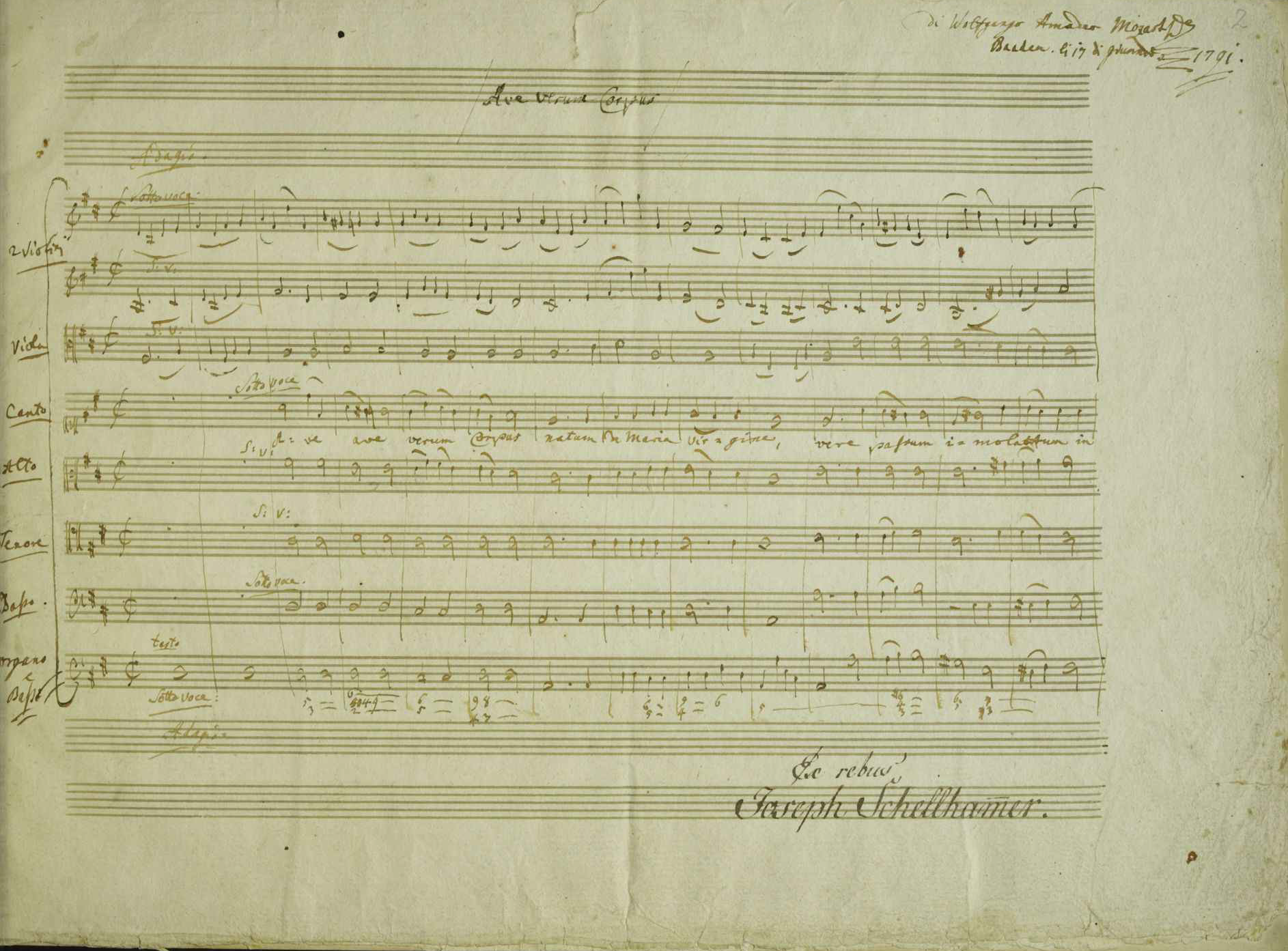
Baden, a spa town south of Vienna, 17 June 1791. Constanze Mozart is taking the cure, pregnant with her sixth child; her husband joins her when he can. The choirmaster of the local parish, Anton Stoll, is a friend who does favours, finds lodgings, keeps contacts: and for the feast of Corpus Christi, which falls on 23 June, he receives the most disproportionate gift in the history of favours between colleagues. Mozart hands him a motet for choir, strings and organ, dated in his own hand: forty-six bars in D major. Ave verum corpus, K 618. Today it is one of the most performed pages on the planet; for Stoll it was the piece for Thursday’s service.
The document of this instalment is two texts, to be read stacked. The first is the fourteenth-century Eucharistic hymn that Mozart sets: Ave verum corpus natum, de Maria Virgine, vere passum immolatum, in cruce pro homine. The second is the beginning of the strophe that closes the sequence for the dead attributed by tradition to Thomas of Celano, the friar whose verses the Church sang at funerals and that the Requiem sets at the point that instalment five left suspended: Lacrimosa dies illa, qua resurget ex favilla, judicandus homo reus. Now count, syllable by syllable. A-ve ve-rum cor-pus na-tum: eight. La-cri-mo-sa di-es il-la: eight. Ve-re pas-sum im-mo-la-tum: eight. Qua re-sur-get ex fa-vil-la: eight. The two texts walk at the same pace, the trochaic tetrameter, the accent falling on the odd syllables, the iron metre of Latin liturgical poetry. It is not a mystical coincidence: it is the family metre of medieval hymns. But it means one very concrete thing: music built on the one fits the other like a garment in the right size.
Where the sums do not come out perfectly, and in some lines they do not, the answer lies in a technique every workshop possessed and that our era has forgotten to consider: re-syllabification. A long note splits into two repeated notes, a word is repeated, a small melisma stretches or contracts, and the new text settles onto the existing music without the music noticing. It is not theory: it is what Mozart himself did in the Davidde penitente of instalment two, where the Italian syllables of a new libretto took the place of the Latin of the mass. Nor is it an emergency trick of the eighteenth century: seventy years later Rossini, in the Petite Messe Solennelle, redistributes the sacred text over his own lines, repeating vowels and words with the ease of a tailor moving a button. It is the work of an expert copyist, measurable in hours, not in inspirations.
The argument, then, holds in three steps. In June 1791, while the Requiem enters his life, Mozart writes a short sacred motet, choral, syllabic, in D, of a hushed and funereal tone although destined for a feast: anyone who has sung it knows that low light that looks less like a procession than a farewell. That motet is written on the same poetic metre as the strophe the Requiem lacks most. And the technique for passing from one text to another was ordinary workshop heritage, practised by the author in person six years earlier. We are not claiming, mind, that the Ave verum is the Lacrimosa in disguise, nor that Mozart wrote it for that purpose: that would be more than the papers allow, and this inquiry has set itself never to go beyond the papers. We are claiming what the papers allow: that in June 1791 there existed, in Mozart’s hand, the dress rehearsal of a procedure, the short sacred garment cut to the right metre, with the tailoring technique ready on the table.
The last fact is an experiment every reader can do tonight, with any recording and the text in front of them. Listen to the Ave verum. Then listen again, trying to sing over it, softly, the words of the Lacrimosa.
This chapter is part of Enrico Melozzi’s inquiry into the Requiem. Instalment seven comes out on Saturday 19 September at 6.30 pm, puts sixteen masses on the table and counts the keys one by one.