

Vienna, 28 July 1741, the house of Agatha Waller on the Kärntnerstraße. The register of funerals at St Stephen’s, the Bahrleihbuch for the year, on folios 177v and 178r, records one dead man: “Antonius Vivaldi, secular priest, died of internal inflammation, aged sixty.” He was sixty-three. Already the first line gets it wrong.
The bill is as detailed as an invoice, because it is an invoice. Nineteen florins and forty-five kreuzer in all, of which two florins and thirty-six for the tolling of the small bells, and then the pall, the grave, six bearers, the lanterns, a sacred image. Burial at the Spitaller Gottsacker, the cemetery of the city hospital in the Wieden, not in the cathedral crypt. In a field.
On this sheet of paper a fable has been built that has lasted seventy years, the one about the nine-year-old boy who supposedly sang at the funeral, a certain Joseph Haydn, then a puer cantor at St Stephen’s. It was born in 1948, when Marc Pincherle read the word Kuttenbuben in the register and translated it “enfants de chœur.” They were not altar boys, they were six grown men in cassocks, paid to carry and to accompany in silence. And nobody sang, for the simplest reason there is: no singing appears among the payments. In Vienna in 1741 music had a price written on the expense note, and what does not appear on the note did not happen.
The other phrase everyone repeats needs correcting too, the one about the common grave as a sign of destitution. Nineteen florins and forty-five kreuzer was the normal expense for a Viennese adult, and funerals of the poor were free. Vivaldi was not buried like a beggar, he was buried like anyone else, which on reflection is worse. Not a misfortune: an accounting indifference.
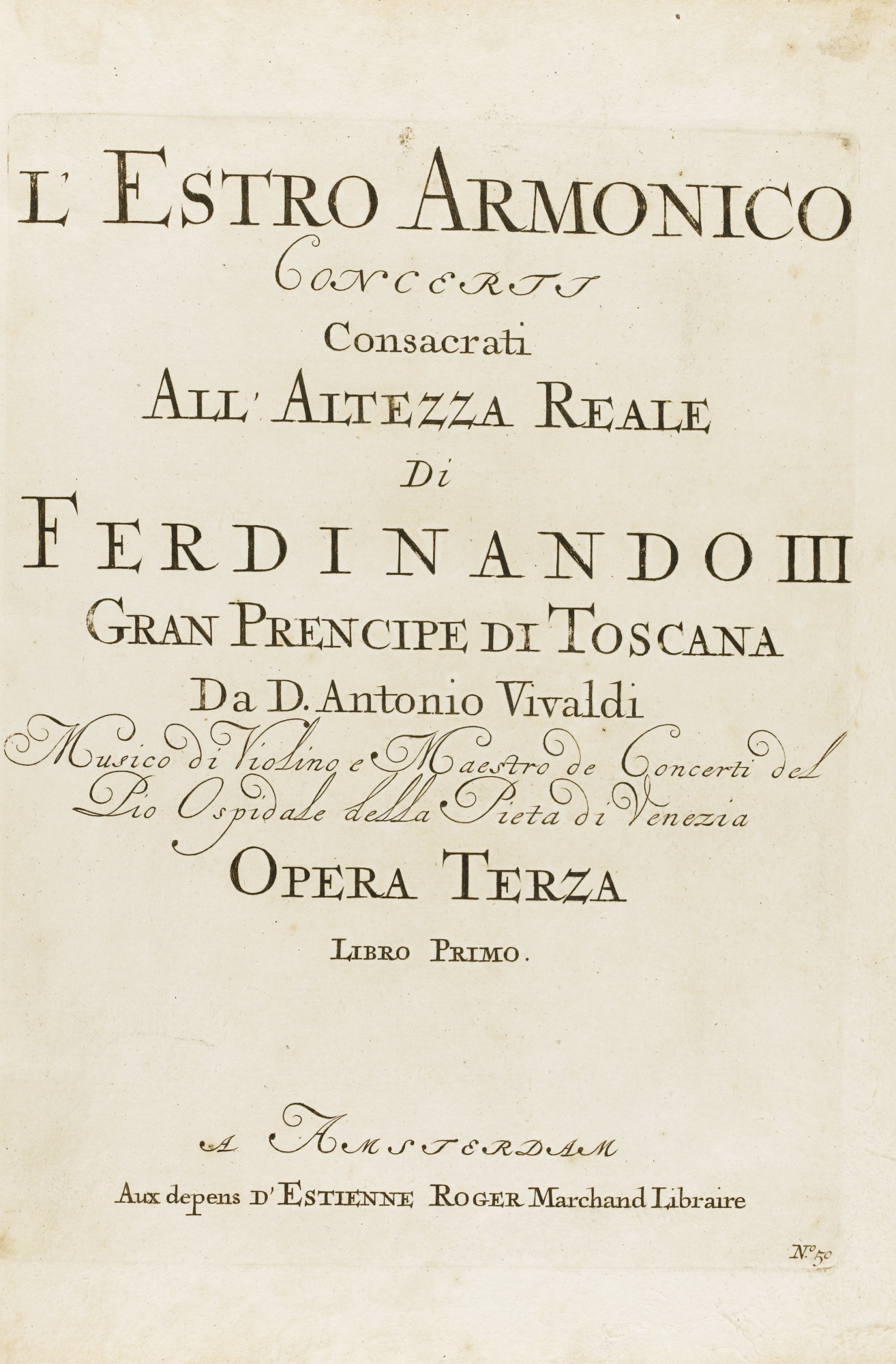
But the point is not how it ended. It is that he had already vanished before he died, and that what vanished was not the music. In 1711 Estienne Roger printed L’estro armonico in Amsterdam, twelve concertos dedicated to Ferdinando de’ Medici, and a few years later, at Weimar, an organist copied them out by hand and rewrote them for keyboard: these are BWV 972, 976 and 978 for harpsichord, BWV 593 and 596 for organ, and 1065 for four harpsichords. The organist is Bach, and the form of the Italian concerto was taught to him by a Venetian priest he would never meet.
Then Vivaldi drops out of circulation for two centuries, while those transcriptions go on being played under Bach’s name. The music survives, the signature does not. When prints, theatres and copies stop passing music from hand to hand, that music stays written and ceases to exist, and quality has nothing to do with it: the criterion was never that.
That he had been in that circulation, for as long as it lasted, is proved by a drawing. Rome, 1723: Pier Leone Ghezzi portrays in profile a man with an impossible nose and writes beneath it: “The Red Priest, Composer of Music, who did the opera at Capranica in 1723.” The sheet is in the Vatican Library, Ottoboniani latini 3114. Caricatures are made of living people whom everyone recognises, and in 1723 Vivaldi was someone you recognised by his nose.
The return, when it comes, has a date and above all a price. Autumn 1926: Alberto Gentili teaches music history at the University of Turin, Luigi Torri directs the National Library, and a Salesian college at San Carlo, in the Monferrato, has to finance building work and puts its music library up for sale. Crates arrive. Inside are bound volumes of concertos, operas, sonatas, sacred music, largely autographs.
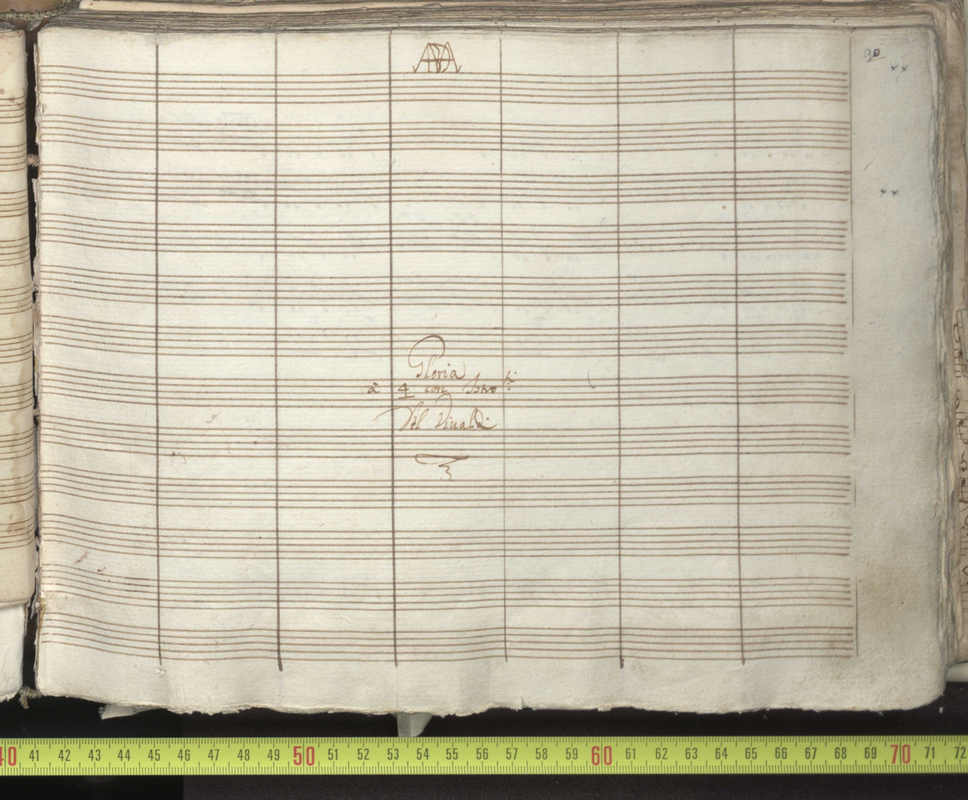
A professor does not have that kind of money. Roberto Foà does, a Turin banker, who buys and donates in 1927, and the collection takes the name of his dead child: Mauro. Then it turns out that half the papers are missing, and the archivist Faustino Curlo follows the trail to Genoa, to Giuseppe Maria Durazzo, heir of that Count Giacomo who had gathered those sheets in the eighteenth century. Three years of negotiation. In 1930 Durazzo sells for a hundred thousand lire, paid by Filippo Giordano, a textile industrialist, and the second collection also takes the name of a dead child: Renzo. Delivery date, 30 October 1930.
It is worth rereading. More than ninety per cent of Vivaldi’s surviving autographs are in Turin because two fathers who had buried a son decided to spend their money there, and not because a ministry had a policy or a funding call had a deadline. Two families in mourning and a professor who did not let go.
The rest follows, with a date that says more than any commentary: in September 1939 Alfredo Casella organises in Siena the first Settimana Musicale Senese and puts in it the Gloria, the Credo, the Stabat Mater, L’Olimpiade, from 16 to 21 September. Look at what was happening in Europe that week. The repertoire always reopens at the wrong moment, because the right moment never comes.
Today the catalogue is open, indexed, digitised and free to consult. Vivaldi credited himself with ninety-four operas, of which about twenty remain, whole or in pieces, and the concertos on record number around five hundred. In a season we play four, the first four of his Opus 8, Il cimento dell’armonia e dell’inventione, printed in Amsterdam in 1725. Four out of five hundred is zero point eight per cent. What is missing is not the music but someone to programme it.
And it is worth keeping in mind the next time someone says that audiences reward masterpieces and that time does justice. Time does nothing. Vivaldi did not come back because his music was beautiful; it was just as beautiful in the two hundred years when nobody played it. He came back because someone paid for the crates. Beauty alone has never opened a season.