

by Enrico Melozzi
This is instalment thirteen of thirteen, the last. The thesis is in instalment one and has not changed. Here we take stock.
Vienna, December 1791, the apartment in the Rauhensteingasse. On the table, the manuscript gatherings of the Requiem. Over the next two hundred and thirty years, around those sheets, more completers will sit down than any other work in history has had. The first is a twenty-six-year-old who gives up, the second a twenty-five-year-old who delivers. Then, for almost two centuries, operational silence: Süssmayr’s version reigns. Finally, from 1971, the line starts up again and has never stopped. This final instalment surveys the building site, and at the end points to the door nobody has ever opened.
The survey is by criteria and not by report cards, as this inquiry has bound itself to do: positions are debated, persons are respected. Franz Beyer, 1971, corrects Süssmayr’s instrumentation where Süssmayr’s craft creaks: it is the restoration of the restoration. Richard Maunder, 1988, makes the radical choice: he throws out whatever has no autograph foothold, Sanctus and Benedictus included, and reconstructs the Amen fugue from the Berlin sketches that we know from instalment five. Robbins Landon, 1991, makes the opposite choice: he recovers the work of Eybler, the first man asked, and integrates it with Süssmayr, in the name of historical proximity. Duncan Druce, who has been working on it since 1984, recomposes on his own with declared freedom. Robert Levin corrects with the hand of a practising Mozartian, keeping the historical framework and refining the counterpoint. Benjamin-Gunnar Cohrs, Pierre-Henri Dutron, Michael Ostrzyga, Masato Suzuki, between 2013 and 2017, refine, each with his own philology, some starting again from Eybler, some redrawing Süssmayr as one restores a fresco. The public, meanwhile, goes on almost everywhere listening to the twenty-five-year-old of 1791, and has its reasons: that version carries two centuries of mourning on its shoulders, and patina, in music, is a form of truth.
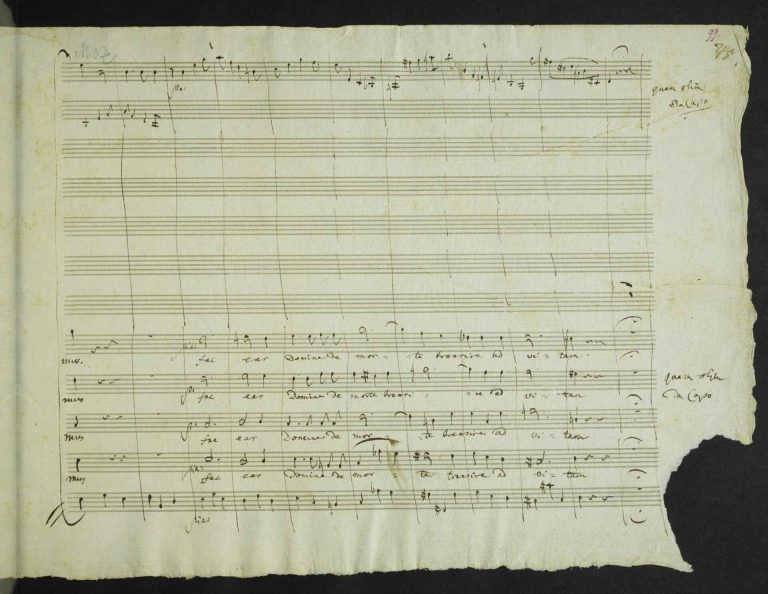
Now the observation, which is the reason this inquiry exists. Line up the criteria: correct Süssmayr, replace Süssmayr by composing anew, recover Eybler, compose in style with superior skill. For the three numbers without a single autograph line, Sanctus, Benedictus and Agnus Dei, all the roads taken come down to two: keep the music written by the assistant, or write new music. Nobody, in two hundred and thirty years, has tried the third road: to derive those numbers from sacred music by Mozart that already exists, chosen for text, key and scoring, and re-syllabified as a workshop of 1791 knew how to do. Yet, if the twelve preceding instalments of this inquiry have proved anything, it is that this third road is not a modern whim: it is the road indicated by the documented habits of the author, by the public precedent of 1785, by the way the production chain worked, by the nature of the commission, by the tonal map of his sacred catalogue and by the liturgical year of his life. Musicology has explored every path except the one that starts from the front door of the house.
Why? I believe for a reason that is not technical but cultural, and we have met it several times this month: the museum. The museum can restore, the museum can even redo the frame; but the museum cannot admit that the painting was half a workshop job, because on that admission the story of the masterpiece fallen from heaven collapses. Deriving the Sanctus from a Salzburg mass would mean declaring, in the score, that Mozart was a professional inside a productive system. This inquiry has declared it in prose for twelve instalments. It remains to declare it in music.
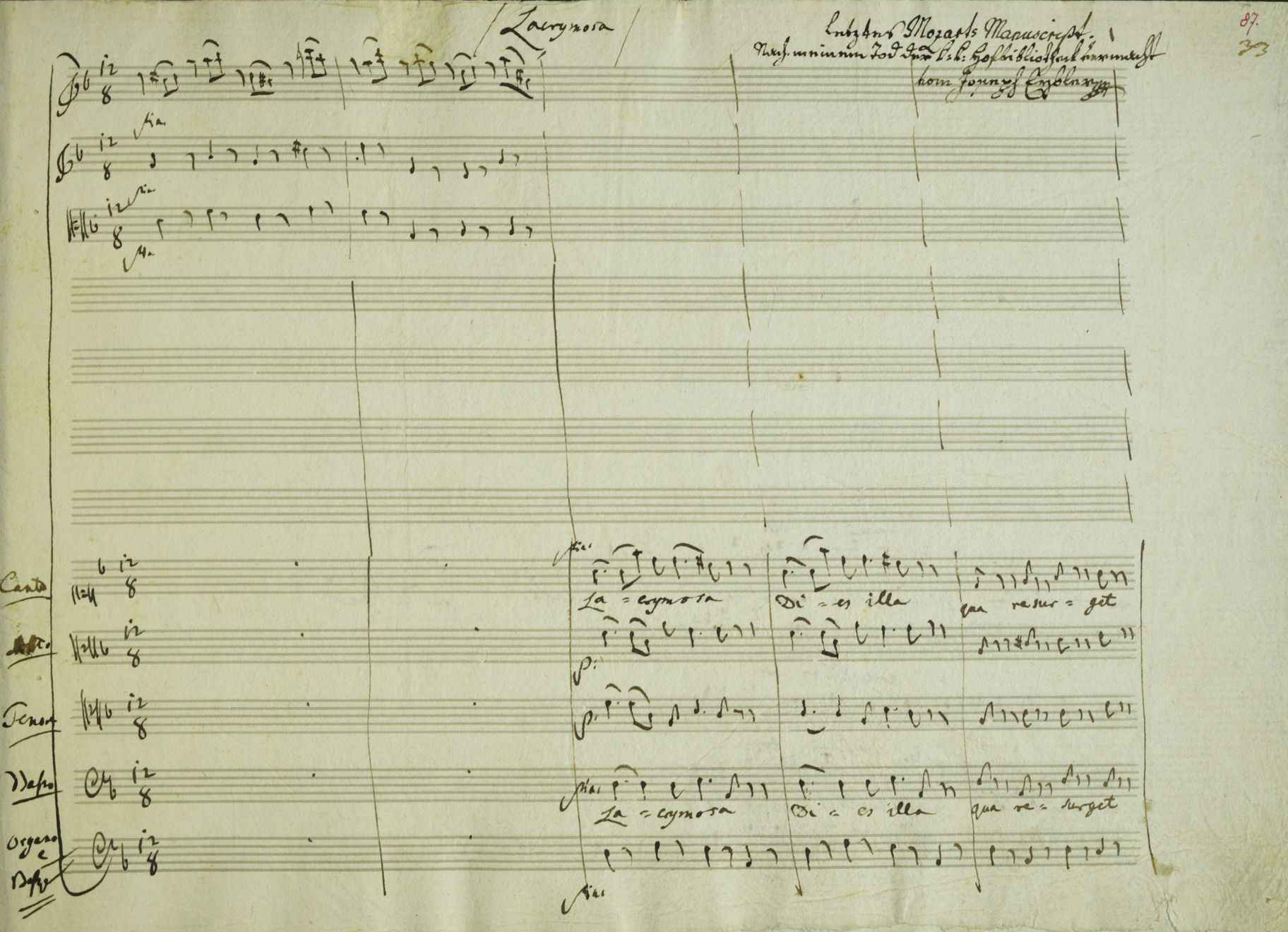
And here comes the announcement, which I sign with my own name because responsibilities are signed. I will make that reconstruction. A Requiem in which the three missing numbers will be neither composed by me nor kept from Süssmayr, but derived from Mozart’s sacred catalogue, with the Köchel numbers declared on the table, movement by movement, and every intervention of re-syllabification and linking documented in the score, distinguishable by eye as the different hands are distinguishable on the Vienna autograph. It will not be the Requiem as Mozart would have made it: no one can honestly write that sentence, and I warn anyone who does. It will be the Requiem as his workshop could have delivered it, following the instructions the papers contain and the habits the documents prove. The difference between the two formulas is the whole distance between legend and craft, and it is the distance this magazine exists to measure.
One last thing, the most important. A thesis that cannot be disproved is not a thesis, it is a faith, and Melos does not publish faiths. Anyone with documents that contradict what has been written in these thirteen instalments, a paper, a date, a watermark, is invited to send them: they will be published on these pages, with the prominence they deserve, beside the permanent archive of the inquiry. If the refutation holds, the thesis will fall, and we shall have lost a theory and gained a truth: for a publication it is the best bargain possible. The table is laid, the papers are cited, the catalogue numbers will arrive with the score. On 5 December 1791, at five minutes to one at night, a professional left an organised delivery on the table of his house. More than two centuries late, the delivery has to be completed.
Enrico Melozzi’s inquiry into the Requiem remains collected, in full and for good, on its permanent page.