

by Enrico Melozzi
This is instalment seven of thirteen. The thesis is in instalment one and does not change. What follows is meant to prove it.
Salzburg, cathedral sacristy, an ordinary Sunday in the 1770s. Before the service, the Kapellmeister chooses the day’s mass from the music pantry: used fascicles, recopied, adapted, with the names of the movements on the spine. Nobody in that room has ever thought that a mass is an untouchable organism: it is a service in six courses, and the courses, when needed, can be combined. It is this mental room we must enter to read today’s document, which is not a single paper: it is a missal, plus a pile of scores.
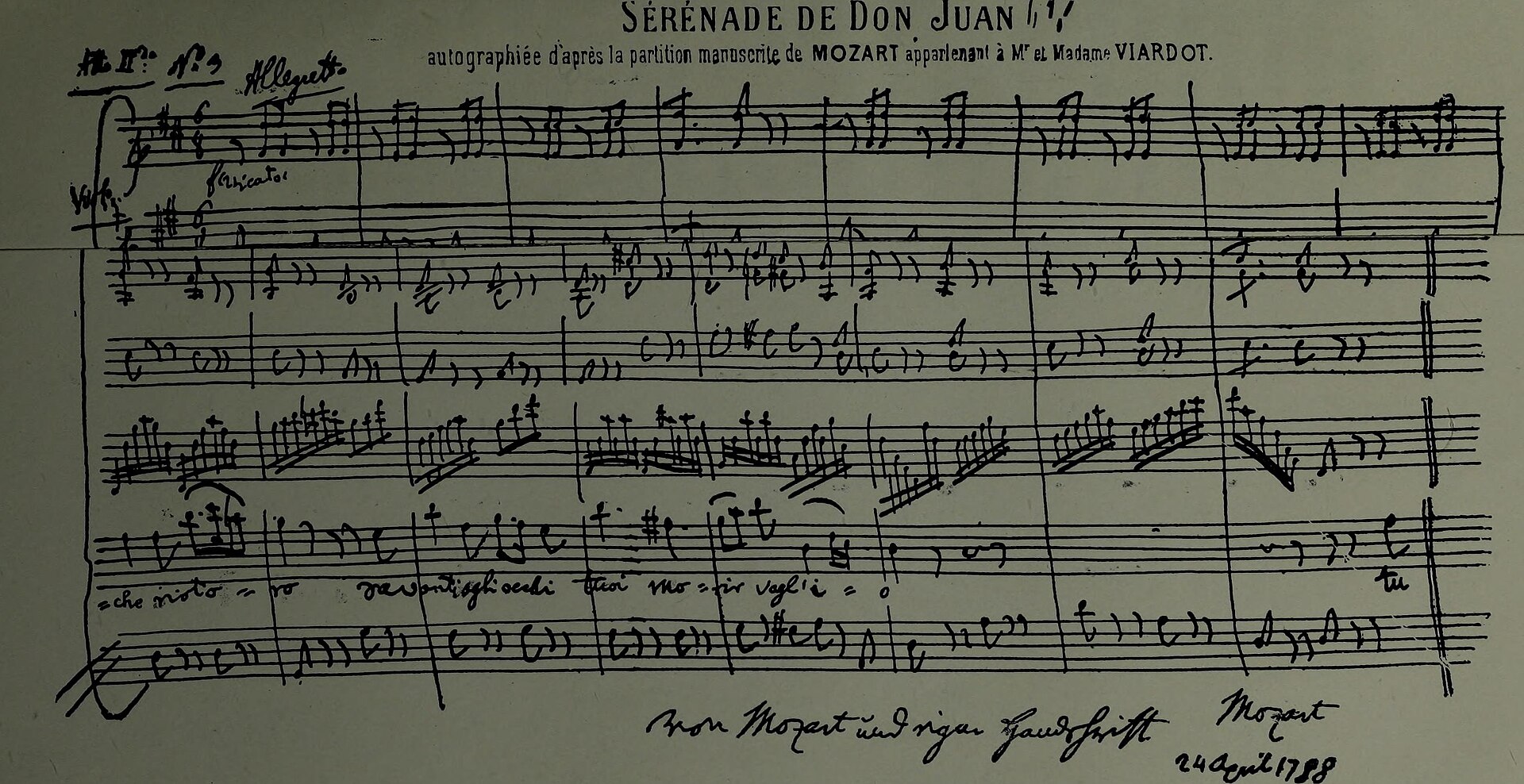
The missal first. The requiem mass is not a rite apart: it is the mass, with the proper texts of mourning in place of those of the day. But three of its numbers belong to the ordinary, that is, the part that never changes. The Requiem’s Sanctus, with its Osanna and the Benedictus, is word for word the Sanctus of any mass: no difference, no addition, nothing. The Agnus Dei changes only the closing clause: where every mass says miserere nobis and dona nobis pacem, the Requiem says dona eis requiem and dona eis requiem sempiternam. Different syllables at the tail, and instalment six showed that syllables at the tail can be re-syllabified: copyist’s work, measurable in minutes. The consequence is brutal in its simplicity: music written by Mozart for the Sanctus, Benedictus and Agnus of any mass sits over the Requiem’s texts without touching a note, or almost.
The serious objection remained to be checked, the only one: keys. The Requiem lives in D minor, and the historical completion calls for a Sanctus in D major, a Benedictus in B-flat major, an Agnus Dei in D minor. If Mozart’s sacred music lived in orbits far from these centres, the reuse would remain an elegant and impracticable idea. For this we built, score by score, the tonal map of the individual movements of the complete masses, checking it against encyclopedia entries and editions; the full table goes into the Melos library, and here we publish the rows that decide the question.
| Mass | Home key | Sanctus | Benedictus | Agnus Dei |
|---|---|---|---|---|
| K 49 (1768) | G major | G major | C major, soloists | E minor |
| K 65 (1769) | D minor | D minor | G minor, duet | D minor |
| K 194 (1774) | D major | D major | G major | B minor, then D |
| K 220 (1775-77) | C major | C major | G major, soloists | C major |
| K 275 (1777) | B-flat major | B-flat major | E-flat major | G minor |
Let us read it together, because every row works for us. First: the Sanctus sits at the home key and the Benedictus moves away from it, to the subdominant or the dominant, entrusted to the soloists, with the Osanna returning to the home key: it is the house rule, and the historical completion of the Requiem respects it to the letter, a sign that it respected a habit of the author. Second: the Agnus Dei seeks the minor, the relative key or the dark mode, in four cases out of five: an Agnus in D minor is not an anomaly to be justified, it is the norm applied to the Requiem. Third, and decisive: the required keys already exist, physically, in the catalogue. A Mozart Sanctus in D major exists: K 194. Mass movements in B-flat exist: K 275 is full of them. An entire ordinary in D minor, Sanctus and Agnus included, exists: K 65, written at twelve, and we certainly do not propose to transplant it bodily into the Requiem; we enter it into the record because it shows that the liturgical orbit of D minor was frequented by Mozart, not an exotic continent. And for the Viennese years the proof is the Kyrie K 341, in D minor, with Requiem-sized forces: a piece which, we say at once for honesty of method, serves as the source of no Sanctus, because it has the cut, the pace and the distribution of invocations of a Kyrie and of nothing else. It serves as a thermometer: in the Vienna years Mozart wrote liturgy in D minor, with those colours.
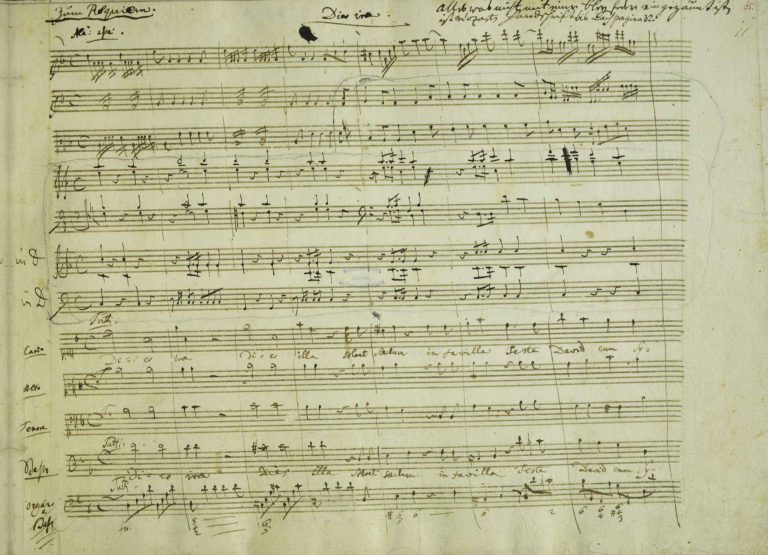
The reasoning closes on its own. Identical or re-syllabifiable texts. Required keys that coincide with the normal orbit of the sacred catalogue. An author who had already practised the transfer in public, as instalment two documented. And a workshop equipped to carry it out. Whoever wants to maintain that the three missing numbers had to be composed from scratch anyway must explain why the one impossible road would be precisely the one that the missal, the catalogue and the practice made the most natural. The material was there, and it was compatible.
This chapter is part of Enrico Melozzi’s inquiry into the Requiem. Instalment eight comes out on Tuesday 22 September at 6.30 pm, and enters St Stephen’s Cathedral with a simple question: what was Mozart doing there in May 1791?